 Apple Podcasts
  Spotify
  Amazon Music
  Podcast Addict
  Youtube Music
  Audible
  Goodpods
  Castbox
  Overcast
  Deezer
  Podchaser
  PlayerFM
  Castro
  TuneIn
 The world's leading Spinoza scholar on heresy, "God or nature", and why the great philosopher of toleration was an atheist after all
"If there's a theme that unites all of Spinoza's philosophical writings, it's freedom: both personal freedom, how we become liberated from irrational passions, and political and social freedom, freedom of expression, freedom of belief and freedom of association." — Steven Nadler
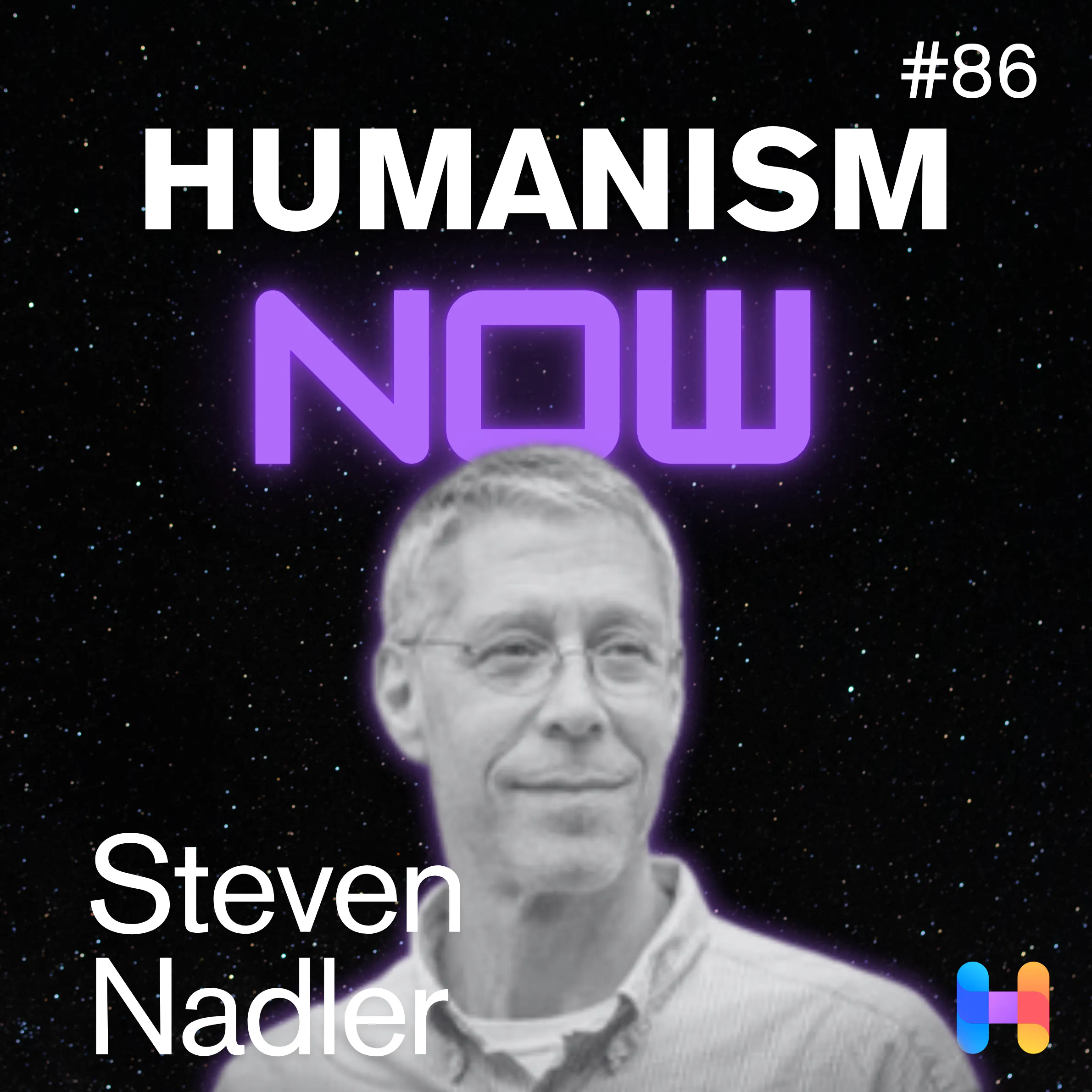
Support Humanism Now & Join Our Community! Baruch Spinoza was excommunicated by his own community, condemned across Europe, and called the most dangerous philosopher of his age. Centuries later, scholars still argue over what he actually believed. In this episode, James Hodgson speaks with Steven Nadler, one of the world's foremost authorities on Spinoza, about the man, his radical ideas, and the case that Spinoza was, in the modern sense, a genuine atheist.
We explore what "atheist" even meant in the 17th century, why "God or nature" is not the same as pantheism, how Spinoza's defence of democracy and free expression anticipated modern liberal values, and why Einstein said his God was Spinoza's God.
About the guest
Steven Nadler is a Vilas Research Professor and the William H. Hay II Professor of Philosophy at the University of Wisconsin–Madison, and one of the world's leading authorities on Spinoza. A Pulitzer Prize finalist, his books include Spinoza: A Life and A Book Forged in Hell. His latest is Spinoza, Atheist.
In this episode
- Who Spinoza was, his 1656 excommunication, and why his works were branded "soul-destroying" and "forged by the devil"
- What "atheist" meant in the 17th century, and how it differs from Spinoza's atheism in the modern sense
- Why "God or nature" (Deus sive natura) marks the line between the pantheist and the atheist
- Spinoza's timeless case for democracy, freedom of belief, and separating church from state
Chapters
00:00 Introduction: who was Spinoza? 01:27 Excommunication and the major works 03:51 The Dutch Republic, Amsterdam and religious tolerance 06:23 What "atheist" meant in the 17th century 09:59 Adriaan Koerbagh and the Theological-Political Treatise 13:35 What Spinoza was really advocating for 16:32 How radical the ideas were, and how they spread 20:23 "God or nature": the pantheism question 24:19 Einstein's God and Spinoza's God 26:03 The many Spinozas: interpretation vs claiming him 29:06 Why Spinoza was an atheist in the modern sense 30:13 Was Spinoza a humanist? 32:08 Spinoza's legacy: freedom and human flourishing 34:45 Closing question: changing his mind
Links and references
Steven Nadler
- Spinoza, Atheist (Princeton University Press): https://press.princeton.edu/our-authors/nadler-steven
- A Book Forged in Hell: https://www.amazon.com/Book-Forged-Hell-Spinozas-Scandalous/dp/069116018X
Spinoza's works and resources
- The Ethics (full text, Project Gutenberg): https://www.gutenberg.org/ebooks/3800
- Theological-Political Treatise (full text, Project Gutenberg): https://www.gutenberg.org/ebooks/989
- Museum Het Spinozahuis, the Spinoza House: https://spinozahuis.nl/en/home-en/
- Baruch Spinoza, Stanford Encyclopedia of Philosophy: https://plato.stanford.edu/entries/spinoza/
Enjoyed this episode? Please leave a rating and review, and share it with a friend.
Join our community on Ko-fi for exclusive content and to support the show. Support Humanism Now & Join Our Community!
Follow us on all socials @HumanismNowPod | YouTube | TikTok | Instagram | Facebook | Threads | X.com | BlueSky
Humanism Now is produced by Humanise Live a podcast production agency based in London, serving charities, companies, and individuals across the globe.
Contact us to get starting in podcasting today at humanise.live or hello@humanise.live
Music: Blossom by Light Prism
Podcast transcripts are AI-generated and may contain errors or omissions. They are provided to make our content more accessible, but should not be considered a fully accurate record of the conversation.
Learn more about your ad choices. Visit megaphone.fm/adchoices